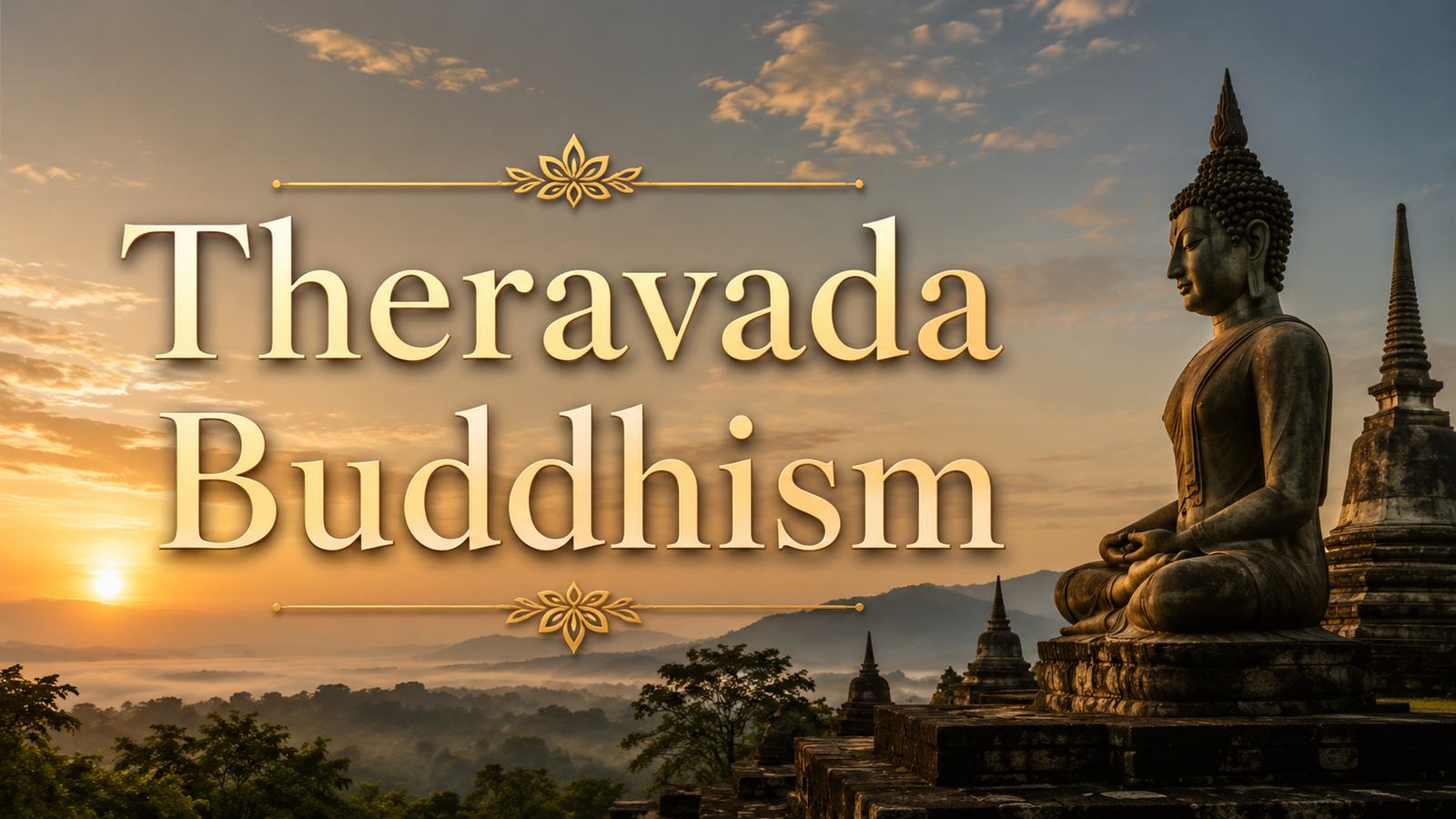
Buddhism is a path of understanding and practice taught by Siddhartha Gautama, whom Buddhists call the Buddha, meaning “the Awakened One.” Buddhism began in ancient India more than 2,500 years ago. It is not simply a religion that asks people to believe in certain ideas. At its heart, Buddhism is a way of understanding why human beings suffer, why we continue to experience dissatisfaction, and how suffering can come to an end.
The Buddha did not teach that life is hopeless. Rather, he taught that suffering has causes, and because it has causes, it can also come to an end. He then showed a practical path for reaching that freedom.
Over the centuries, Buddhism developed into several major traditions. The three main traditions known today are Theravada, Mahayana, and Vajrayana. Although they differ in scriptures, practices, ideals, and historical development, they all trace their teachings back to the Buddha and share many fundamental teachings, such as the Four Noble Truths, karma, rebirth, impermanence, and the goal of liberation.
Among these traditions, Theravada is the main Buddhist tradition found today in Sri Lanka, Thailand, Myanmar, Cambodia, and Laos. It is also practiced by communities throughout the world.
The Meaning of Theravada
The word Theravada means “Teaching of the Elders” or “Doctrine of the Elders.” The name refers to the tradition that understands itself as preserving the teachings and discipline transmitted through the early Buddhist community.
Theravada places great importance on the early Buddhist scriptures preserved in the Pali Canon, also called the Tipitaka, meaning “Three Baskets.” The Pali Canon is the largest surviving collection of early Buddhist scriptures preserved in an ancient Indian language.
However, it is important not to think of Theravada as simply a religion that has remained completely unchanged since the Buddha’s lifetime. Theravada itself has a long history. Its scriptures, commentaries, monastic traditions, meditation systems, rituals, and institutions developed over many centuries. Nevertheless, it has maintained a particularly strong connection with the early Buddhist teachings and the monastic discipline.
The Buddha and the Beginning of Buddhism
The Buddha was born as Siddhartha Gautama in the region of ancient northern India. According to the traditional account, he lived a protected life when he was young. Later, after encountering sickness, old age, death, and a renunciant, he began to deeply question the nature of human existence.
He eventually left his comfortable life and became a seeker. For years he practiced under different teachers and also practiced severe asceticism. He eventually realized that neither extreme luxury nor extreme self-mortification was the way to liberation.
He therefore taught what became known as the Middle Way.
According to Buddhist tradition, Siddhartha Gautama attained awakening while meditating under the Bodhi tree at Bodh Gaya. From that point onward, he was known as the Buddha.
For approximately forty-five years, the Buddha traveled through northern India teaching monks, nuns, laypeople, kings, merchants, farmers, and people from many different backgrounds.
His teachings eventually formed a large community known as the Sangha.
What Did the Buddha Teach?
The Buddha’s teaching can be understood as a practical investigation into the human condition.
One of his most important teachings is the Four Noble Truths.
The first truth is that there is dukkha. Dukkha is often translated as “suffering,” but the word has a wider meaning. It includes obvious suffering such as sickness, aging, grief, and death, but it also includes the deeper dissatisfaction that comes from trying to hold on to things that cannot remain permanently.
The second truth is that dukkha has causes. One of the most important causes is craving—the constant desire to obtain, possess, become, avoid, or control.
The third truth is that dukkha can cease. Liberation is therefore possible.
The fourth truth is the path leading to the cessation of dukkha: the Noble Eightfold Path.
The Eightfold Path consists of:
- Right View
- Right Intention
- Right Speech
- Right Action
- Right Livelihood
- Right Effort
- Right Mindfulness
- Right Concentration
The word “right” here does not simply mean morally correct. It can also mean appropriate, skillful, or leading toward liberation.
The Three Marks of Existence
Theravada Buddhism also emphasizes three characteristics of conditioned existence.
The first is impermanence (anicca). Everything conditioned changes. Our bodies change, feelings change, relationships change, possessions change, and even our thoughts change.
The second is dukkha. Because conditioned things are unstable, they cannot provide permanent and complete satisfaction.
The third is non-self (anatta). Buddhism does not find within the changing body and mind an eternal, unchanging personal self that exists independently of conditions.
These teachings are not merely philosophical ideas. Buddhism encourages practitioners to observe these truths directly through mindfulness and meditation.
Karma and Rebirth
Another important part of Theravada Buddhism is the teaching of karma.
Karma literally means action. In Buddhism, it particularly refers to intentional actions of body, speech, and mind. Actions have consequences. Wholesome intentions tend to produce wholesome results, while unwholesome intentions tend to produce harmful results.
Buddhism therefore teaches personal responsibility. Our actions matter.
Theravada Buddhism also teaches rebirth. According to Buddhist teaching, beings continue through the cycle of birth and death, known as samsara, because ignorance, craving, and attachment remain.
This cycle is not understood as an eternal soul traveling from one body to another. The Buddha’s teaching of non-self makes the matter more subtle. Instead, rebirth is explained through a continuing process of causes and conditions.
A useful comparison is a flame being used to light another flame. The second flame is not exactly the first flame, but it is not completely unrelated to it either.
The ultimate goal is to bring this cycle of suffering to an end.
Nibbana: The Goal of Buddhism
The highest goal in Theravada Buddhism is Nibbana.
Nibbana is commonly translated as “Nirvana.” It refers to the ending of greed, hatred, and delusion and, ultimately, liberation from samsara.
It is not simply a beautiful place in the sky or another temporary heavenly existence. Buddhism teaches that even heavenly beings remain within samsara and eventually experience change and death.
Nibbana is therefore fundamentally different from a heavenly rebirth.
A person who completely destroys the causes of suffering is called an Arahant, meaning a fully liberated person. The Buddha was also an Arahant, but he discovered the path by himself and then taught it to others.
Theravada places great importance on the possibility of liberation through understanding, upholding precepts, meditation, and wisdom.
The Three Trainings
Theravada practice can also be understood through three great areas of training:
Sila — morality
This means training oneself to avoid harmful actions and develop wholesome conduct. Lay Buddhists commonly undertake the Five Precepts:
- Not to kill living beings.
- Not to take what has not been given.
- Not to engage in sexual misconduct.
- Not to speak falsely.
- Not to consume intoxicants that lead to heedlessness.
And a monk needed to uphold 227 major precepts, known as the Patimokkha, which are recorded in the Vinaya Pitaka.
Samadhi — concentration and mental development
This involves developing a stable and concentrated mind through meditation.
Theravada traditions preserve various forms of meditation, including samatha, which develops calm and concentration, and vipassana, which develops insight into the nature of reality.
Panna — wisdom
Wisdom means seeing reality clearly, especially impermanence, dukkha, and non-self, and understanding the causes and cessation of suffering.
These three trainings support one another. Good conduct helps calm the mind. A calm mind supports meditation. Meditation supports wisdom. Wisdom leads toward liberation.
The Pali Canon
One of the greatest achievements of the Theravada tradition is the preservation of the Pali Canon, or Tipitaka.
The Canon is traditionally divided into three sections.
The first is the Vinaya Pitaka. It contains the rules and procedures governing the life of monks and nuns.
The second is the Sutta Pitaka. It contains discourses attributed to the Buddha and, in some cases, his senior disciples. It contains teachings on morality, meditation, wisdom, karma, rebirth, liberation, and many other subjects.
The third is the Abhidhamma Pitaka. It presents a systematic and analytical treatment of Buddhist teachings, especially concerning mental and physical phenomena.
The Pali Canon is therefore not one single book. It is a very large collection of texts.
If you want to buy the entire Pali Canon (Tipitaka) in English – Click Here
How Were the Buddha’s Teachings Recorded?
This is one of the most interesting parts of Buddhist history.
The Buddha lived in a largely oral culture. Writing existed in ancient India, but important religious teachings were commonly preserved through memorization and oral recitation.
After the Buddha’s death, his disciples are traditionally said to have gathered and recited his teachings. Different groups of monks were responsible for memorizing different collections.
The teachings were passed from teacher to student through repeated communal recitation.
This may seem unreliable to a modern person, but ancient Indian oral traditions could be extraordinarily sophisticated. Texts were memorized using repetition, fixed structures, lists, parallel passages, and communal recitation. These methods helped preserve large amounts of material for generations.
The Buddhist tradition also tells of an early gathering known as the First Buddhist Council, where the teachings and monastic discipline were recited.
When Was the Pali Canon Written Down?
According to Theravada tradition, the teachings were eventually written down in Sri Lanka during the reign of King Vattagamani Abhaya, probably around the first century BCE.
According to the traditional account, monks recognized that relying entirely on oral transmission had become dangerous. They therefore committed the teachings to writing.
The Pali Canon was written on palm leaves.
This does not mean that the Buddha’s original manuscripts have survived. They have not. The surviving manuscripts of the Pali Canon are much later copies. What was preserved was a textual tradition transmitted through generations of recitation, writing, copying, editing, and commentary.
Therefore, when we read the Pali Canon today, we are reading the result of a very long process of transmission.
Why Is the Language Called Pali?
The scriptures of Theravada Buddhism are preserved in Pali.
Pali is an ancient Middle Indo-Aryan literary language closely related to the languages spoken in ancient India. It is not simply the everyday language spoken by the Buddha in exactly the form found in the Canon.
The Buddha probably taught in languages or dialects that ordinary people could understand. His teachings were later preserved and transmitted in linguistic forms that eventually became the Pali textual tradition.
For centuries, monks learned Pali so that they could study the Canon directly. Buddhist texts were also translated into English, allowing ordinary people to understand the teachings without needing to know Pali.
From India to Sri Lanka
Although Buddhism began in India, Theravada eventually became especially strong in Sri Lanka.
According to the traditional Sri Lankan Buddhist history, during the reign of Emperor Ashoka in the third century BCE, Buddhist missions traveled to different regions. One important mission was led by Mahinda, who is traditionally described as Ashoka’s son.
Buddhism became established in Sri Lanka and developed a strong monastic tradition.
Sri Lanka became extremely important for the preservation of Theravada Buddhism. Buddhist monasteries became centers of learning, manuscript preservation, education, meditation, and religious practice.
The Sri Lankan tradition also produced important Buddhist literature, including commentaries and historical chronicles.
Theravada in Southeast Asia
Theravada Buddhism became deeply established in Myanmar, Thailand, Cambodia, and Laos.
Each country developed its own Buddhist culture while maintaining strong connections with the Pali Canon and Theravada monastic tradition.
Monasteries became important parts of village life. They were not only places where monks lived. They could also function as centers of education, meditation, religious ceremonies, cultural preservation, and community life.
For many ordinary Buddhists, Buddhism was not limited to meditation. Giving food to monks, making offerings, observing precepts, chanting, visiting temples, listening to Dhamma teachings, making merit, and supporting the Sangha were all important parts of religious life.
Buddhism and the Loss of Buddhism in India
An important part of Theravada history is that Buddhism eventually declined greatly in India, the land where the Buddha lived and taught.
There were many causes. Buddhist institutions depended heavily on monasteries and patronage, and major political and economic changes weakened some Buddhist centers. Buddhism also existed alongside Hindu and Jain traditions and interacted with them for many centuries. Later invasions and the destruction of major monastic universities contributed to the decline of institutional Buddhism in many parts of India.
Yet Buddhism did not disappear from the world.
Sri Lanka and Southeast Asia had already become major centers of Buddhist learning. The teachings continued there even while Buddhism declined in much of India.
This is one of the major reasons Theravada survived into the modern age.
Theravada in the Modern World
From the nineteenth century onward, Theravada Buddhism experienced important changes.
Printing technology made Buddhist texts much easier to reproduce and distribute. Buddhist monks and scholars began publishing books and translating scriptures into modern languages.
There were also Buddhist reform movements in Sri Lanka and Southeast Asia. Some teachers placed renewed emphasis on meditation, study of the Pali Canon, education, and the practical application of Buddhist teachings.
In the twentieth and twenty-first centuries, Theravada Buddhism spread beyond Asia.
Meditation teachers brought Buddhist practices to Europe, North America, Australia, and many other parts of the world. Books, translations, universities, recordings, websites, and now digital media have made Theravada teachings accessible to people who may live thousands of kilometers away from a Buddhist monastery.
Thus, the same tradition that was once preserved by monks memorizing teachings in ancient India can now be studied by someone anywhere in the world with a computer or smartphone.
Is Theravada Only About Monks?
No.
Theravada Buddhism has both monastic and lay communities.
Monks and nuns devote their lives more fully to Buddhist practice and follow extensive rules of discipline. Laypeople live ordinary lives while practicing generosity, morality, meditation, chanting, and Buddhist study.
Lay Buddhists may support the Sangha by giving food and other necessities. This relationship between laypeople and monastics has been an important feature of Theravada society for centuries.
Some people focus mainly on merit-making and devotion. Others emphasize meditation. Others study the scriptures deeply. Some combine all of these practices.
There is therefore no single way in which every Theravada Buddhist practices Buddhism.
Meditation in Theravada Buddhism
Meditation is one of the most important aspects of Theravada practice.
One major form is samatha, the development of calm and concentration. The mind becomes more stable, peaceful, and focused.
Another is vipassana, the development of insight. The practitioner observes the body, feelings, mind, and mental phenomena and learns to see their impermanent and conditioned nature.
The purpose of meditation is not merely to relax.
Relaxation can be a useful result, but the deeper purpose is transformation of the mind. Through careful observation, a practitioner begins to understand how craving, attachment, ignorance, and mental reactions create suffering.
Eventually, Buddhist practice aims at wisdom and liberation rather than merely producing temporary pleasant experiences.
The Buddha as a Teacher
Another important feature of Buddhism is the role of the Buddha.
Theravada does not understand the Buddha as a creator God who created the universe and controls everything that happens.
The Buddha is primarily understood as an awakened teacher.
He discovered the path to liberation, explained it, and showed others how to practice it.
This is why Buddhism places such importance on personal investigation and practice. The Buddha repeatedly encouraged his disciples to understand the Dhamma through direct experience rather than merely accepting teachings because they came from authority.
In this sense, Buddhism is both deeply religious and strongly practical.
Does Buddhism Believe in Gods?
Theravada Buddhism does recognize the existence of various gods or heavenly beings, known in Pali as devas and other classes of beings.
However, these beings are not considered eternal creators of the universe. They too remain within samsara and are subject to impermanence.
A heavenly rebirth is therefore not the final goal.
Even a god can eventually die and be reborn elsewhere.
This is why Buddhism considers liberation more important than obtaining a temporary heavenly existence.
Buddhism as a Path
Therefore, Buddhism can be understood in several ways at the same time.
It is a religion because it has a community, rituals, devotional practices, sacred texts, ethical teachings, temples, monks, and beliefs about karma and rebirth.
It is a philosophy because it asks deep questions about existence, consciousness, identity, suffering, causation, and reality.
It is a practical discipline because it asks people to train their conduct, mind, and wisdom.
And it is a path to liberation because its ultimate purpose is not simply to make life more comfortable. Its highest goal is freedom from the causes of suffering and liberation from samsara.
Why Theravada Still Matters Today
After more than two thousand years, Theravada Buddhism continues to survive because its central questions remain relevant.
People still become sick.
People still grow old.
People still lose people they love.
People still experience anxiety, anger, jealousy, loneliness, disappointment, desire, and fear.
People still search for happiness and discover that many things they thought would make them permanently happy cannot do so.
The Buddha’s teaching begins precisely with this human experience.
It does not tell us that suffering can be avoided simply by wishing it away. Instead, it asks us to look carefully at suffering, understand its causes, and train the mind.
This may be one of the reasons Buddhism has survived for so long.
The scriptures were preserved by generations of monks. The teachings were memorized, recited, written on palm leaves, copied into manuscripts, printed in books, translated into many languages, taught in monasteries, practiced in villages, and eventually transmitted across the world through modern technology.
The physical forms of Buddhism have changed greatly over the centuries, but its central question remains remarkably simple:
Why do we suffer, and is there a way to become completely free?
The Buddha’s answer was that freedom is possible.
He taught that suffering has causes. Those causes can be understood. The mind can be trained. Craving can be abandoned. Ignorance can be overcome. And liberation can be realized.
That is the heart of Buddhism.
………………………………
If you want to read the entire Theravada Buddhism Scriptures, the Tipitaka – Click Here
………………………………